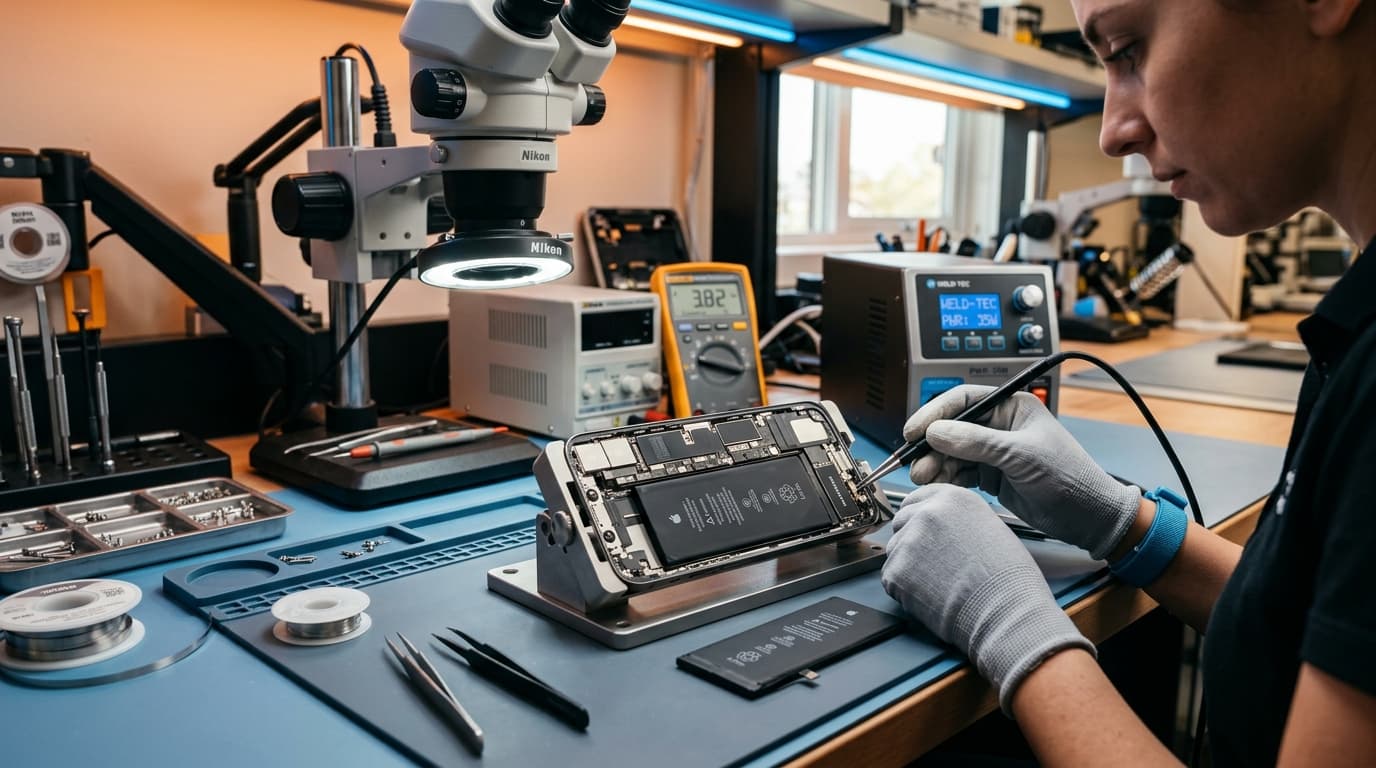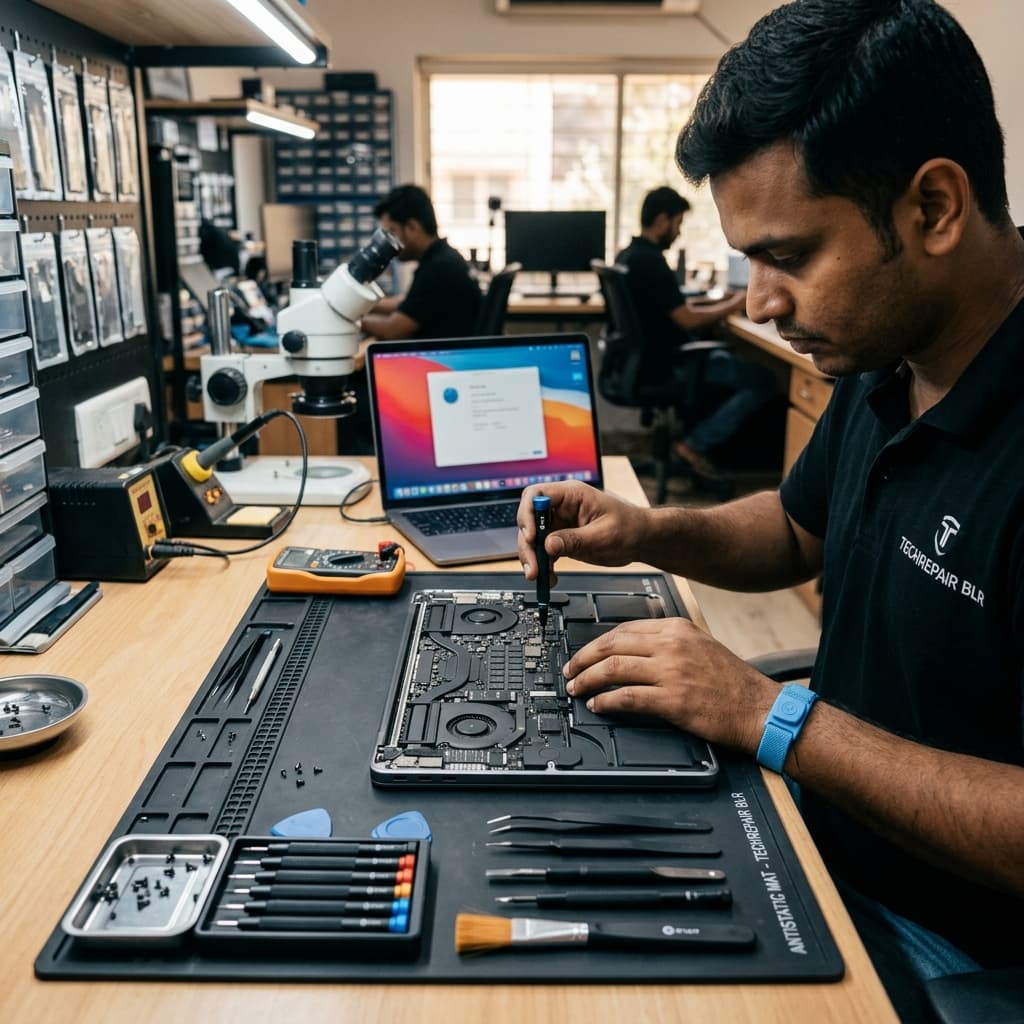
iPhone Laser Back Glass Replacement in Bangalore: Cold Laser, MagSafe & Titanium Guide (2026)

Shattered the back glass of your iPhone 13, 14, 15, 16, or 17? Learn why heat guns ruin MagSafe coils, how cold optical fiber laser ablation vaporizes industrial epoxy safely, how Grade 5 titanium frames are realigned, and how iOne Care Technology restores factory IP68 sealing across Bangalore.
Introduction: The iPhone Back Glass Dilemma in 2026
Over the last several generations of Apple engineering—spanning the iPhone 12 through the cutting-edge iPhone 16 and iPhone 17 Pro Max—Apple has perfected front-facing drop protection through Ceramic Shield crystallite matrices. However, the rear architecture tells a completely different story. To support high-throughput Qi2 wireless charging, high-efficiency MagSafe magnetic coupling, NFC contactless payments, and a luxury frosted tactile finish, Apple utilizes a specialized dual-ion exchange glass back panel bonded directly to an internal chassis.
While this glass feels sublime in the hand, physics remains unforgiving. A single drop onto Bangalore's granite flooring, concrete pavements, or metro concourses can reduce the rear cover to a hazardous web of fractured shards. Beyond aesthetics, fractured back glass exposes internal components to Bangalore's high humidity, dust particulates, and water ingress, jeopardizing the logic board and lithium-ion power cell.
When searching for rear glass repair in Bangalore, iPhone users face a stark divide: Apple Authorized Service Providers (AASPs) demand prohibitive prices by replacing the entire "Rear System" chassis (along with mandatory factory data wipes), while roadside repair shops use crude 300°C heat guns and mechanical razor chisels that frequently melt MagSafe coils and destroy camera stabilizers. At iOne Care Technology, our certified technicians deploy high-precision 1064nm cold optical fiber laser ablation, computer-guided CAD vector shields, and pneumatic pressure curing to replace only the damaged glass while keeping 100% of your data, cameras, and MagSafe charging intact. Here is our master engineering guide to iPhone laser back glass repair in 2026.
1. The 3 Destructive Traps of Roadside "Heat-Gun & Chisel" Repairs
Many independent mobile stalls in Bangalore attempt to replace rear glass using standard hot-air rework stations and handheld dental pry tools. Because Apple bonds rear glass panels with high-tensile industrial epoxy, manual removal without laser ablation causes severe underlying hardware casualties:
1. MagSafe & Qi2 Thermal Rupture
Temperatures above 180°C melt the polyimide enamel coating on the ultra-fine copper wireless induction coils, leading to short circuits, charging slowdowns, or total MagSafe failure.
2. Lithium Battery Puncture Risk
Chiseling hardened epoxy with metal razor scrapers millimeters away from a pressurized lithium pouch can puncture the cell, initiating catastrophic thermal runaway.
3. Camera OIS Magnet Demagnetization
The voice-coil actuators inside Apple's Sensor-Shift Optical Image Stabilization (OIS) mechanisms permanently lose magnetic flux when subjected to direct conductive heat, causing blurred video and camera jitter.
2. The Authorized Route: The "Rear System" Clamshell Dilemma
If you take a cracked iPhone 13, 14, 15, or 16 Pro to an authorized service provider in Bangalore, you are often surprised to learn that Apple's standard procedure does not replace just the glass panel. Instead, Apple mandates an entire "iPhone Rear System" module swap.
- What is a Rear System? It consists of a new metal frame, battery, charging port, wireless coil, and logic board housing—discarding your original working components simply to replace broken glass.
- Mandatory Device Wipe: Authorized protocols require factory-resetting the device. If you haven't completed an iCloud backup or have sensitive banking credentials, your data is wiped permanently.
- Severe Financial Cost: Full Rear System replacements frequently cost between 40% to 60% of the phone's original retail price, making out-of-warranty repairs economically impractical.
The Component-Level Philosophy at iOne Care
At iOne Care Technology, we believe you should never pay to replace components that aren't broken. Our laser separation process targets exclusively the damaged exterior glass and the underlying adhesive matrix, preserving your genuine Apple motherboard, cameras, Face ID sensors, battery, and data intact.
3. The Physics of 1064nm Cold Optical Fiber Laser Separation
How does a laser remove shattered glass without damaging internal electronics? The secret lies in selective optical wavelength absorption and automated computer numerical control (CNC).
A. Optical Transmission vs. Pigment Absorption
Our industrial laser machines emit a concentrated 1064nm infrared beam. At this specific optical frequency, clear borosilicate and aluminosilicate glass is virtually transparent to the beam. The laser energy passes right through the outer glass substrate without heating it, but is completely absorbed by the opaque pigment and high-tack resin adhesive beneath the glass.
Through instantaneous photothermal ablation, the laser beam vaporizes the microscopic adhesive bond in milliseconds, turning the hardened epoxy into inert carbon micro-powder. The glass effortlessly releases from the metallic chassis with zero mechanical prying or heat transfer to internal electronics.
B. CAD Galvanometer Vector Masking
Every iPhone model—from iPhone 12 Mini to iPhone 16 Pro Max and iPhone 17—possesses a unique internal blueprint. Our high-precision laser system uses dual-axis galvanometer mirrors linked to exact CAD vector drawings of each iPhone chassis:
- MagSafe Exclusion Zone: The laser automatically skips the circular perimeter of neodymium alignment magnets and the central Qi copper charging pad.
- Camera & LiDAR Boundary: Precise cutouts ensure the laser beam never touches the sapphire camera lens bezels, LiDAR scanner, or dual-tone flash assembly.
- NFC / Apple Pay Coil Shielding: Preserves the micro-thin flex ribbons responsible for contactless card payments and metro access cards.
4. Frame Mechanics: Grade 5 Titanium vs. Aerospace Aluminum
Modern iPhones feature dramatically different frame metallurgy that dictates how rear glass must be calibrated and installed:
| Chassis Material | iPhone Models | Repair & Structural Nuances |
|---|---|---|
| Grade 5 Titanium (Ti-6Al-4V) | iPhone 15 Pro, 15 Pro Max, iPhone 16 Pro, 16 Pro Max, iPhone 17 Pro | Features an aerospace titanium band bonded to an internal aluminum substructure via solid-state diffusion. Titanium has immense tensile strength but can suffer localized deformation at impact corners. Requires micro-milling and hydraulic leveling so the new rear glass sits with sub-0.1mm flush tolerance. |
| Aerospace-Grade Aluminum (7000 Series) | iPhone 12, 13, 14, 15, 16, 17 Base & Plus Models | Lightweight and ductile. Corner impacts often "mushroom" the soft aluminum lip over the glass edge. Our technicians use diamond precision chamfering files to clear the perimeter before glass fitment. |
| Surgical-Grade Stainless Steel | iPhone 12 Pro, 13 Pro, 14 Pro Series | Extremely rigid, highly resistant to frame flex, but utilizes heavy structural welding around the camera bump. Requires dual-pass laser ablation to cleanly release camera perimeter adhesive. |
5. Restoring IP68 Water & Dust Ingress Protection
A major concern among iPhone owners in Bangalore—particularly during torrential monsoon downpours or high-dust traffic commutes—is whether back glass replacement permanently ruins water resistance.
In standard roadside repairs, technicians apply generic liquid silicone or B-7000 adhesive. These sealants shrink upon drying, break down when exposed to skin oils or Bangalore humidity, and leave gaps where water penetrates immediately. At iOne Care Technology, we restore water resistance using a scientific 3-stage protocol:
- 1. Ultrasonic Perimeter Degreasing: We meticulously clear every trace of carbonized resin and microscopic glass dust using isopropyl ultrasonic wiping pens.
- 2. Structural Polyurethane Reactive (PUR) Gasketing: We apply factory-matched pre-cut waterproof perimeter tape supplemented with UV-inhibited cold-cure PUR adhesive that retains elastic memory under thermal cycling.
- 3. Pneumatic Clamping & Vacuum Curing: The reassembled phone is placed in a custom-molded silicone compression jig under regulated pneumatic pressure (35 PSI) for 20 minutes, ensuring an airtight, gap-free seal that repels dust and water splash.
6. Step-by-Step Lab Walkthrough at iOne Care Technology
Here is what happens to your device during an iPhone laser back glass repair at our Bangalore service center:
-
01
Pre-Repair Multi-Point Diagnostics
We test wireless charging rates, MagSafe magnetic attraction, NFC payment communication, LiDAR sensor calibration, ultra-wide and telephoto focus, and battery health before touching a single screw.
-
02
CAD Mapping & Cold Laser Ablation
The iPhone is mounted onto a precision optical alignment bed. The technician selects the exact device schematic. The 1064nm fiber laser conducts a high-speed vector pass, cleanly breaking down the epoxy adhesive underneath the shattered glass within 8 to 12 minutes.
-
03
Negative-Pressure Glass Extraction
Under a laminar clean hood with continuous HEPA particulate extraction, technicians gently remove loosened glass shards using anti-static precision tools, ensuring zero shards contact internal flex ribbons.
-
04
Second Laser Cleaning Pass
A lower-power secondary laser sweep vaporizes residual adhesive residue from the titanium/aluminum midframe, creating an immaculate bonding surface.
-
05
OEM-Grade Back Glass Installation & Compression Curing
A brand new rear glass panel featuring original color hue, anti-fingerprint oleophobic coating, and precise camera cutouts is aligned with the frame. It is bonded with industrial PUR adhesive and cured in our pneumatic clamping press.
-
06
Post-Repair Verification & Barometric Test
The device undergoes final testing: MagSafe 15W/25W fast charging, Qi2 induction, camera focus across all zoom levels, flash sync, microphone clarity, and barometric internal pressure checks.
7. Engineering Comparison: Authorized Service vs. Roadside vs. iOne Care
Compare the three approaches available to iPhone owners in Bangalore:
| Service Factor | Apple Authorized Service | Roadside Repair Shop | iOne Care Technology Bangalore |
|---|---|---|---|
| Repair Method | Complete "Rear System" module replacement | Manual heat gun (300°C+) & razor pry tools | 1064nm Computer-Guided Cold Laser Ablation |
| Pricing Approach | Full clamshell module cost (often 40-60% of device value) | Cheap initial quote with high hidden risk of component damage | Transparent component-level pricing (focused strictly on rear glass) |
| Customer Data Policy | Mandatory device wipe & factory OS reset | No formal protocol (unmonitored data exposure) | 100% Zero Data Wipe Guarantee (all files & logins intact) |
| MagSafe / Qi2 Safety | Replaced as whole unit | High risk of melting induction coils & magnet misalignment | 100% Protected via CAD vector exclusion masking |
| Turnaround Time | 3 to 7 business days | 3 to 5 hours (often returned with uneven glass edges) | Same-Day (45 to 60 minutes in-lab or Doorstep) |
| Warranty Protection | 90 days | None or 7-day verbal warranty | 6 Months Comprehensive Service Warranty |
8. Frequently Asked Questions (FAQ) About iPhone Back Glass Repair
Will replacing the back glass affect my MagSafe charging or Apple Pay?
No. Because our cold laser machine uses computerized CAD vector templates, it automatically excludes the MagSafe magnetic ring and NFC antenna from the laser beam path. Your MagSafe accessories, wireless charging speeds, and NFC tap-to-pay function identically to factory specifications.
Can I get iPhone back glass repair done at my doorstep in Bangalore?
Yes! iOne Care Technology provides doorstep pickup and on-site service across Bangalore, including Indiranagar, Koramangala, Whitefield, HSR Layout, Electronic City, Bellandur, Marathahalli, and Jayanagar. Our mobile technician can collect your device, conduct laser service at our central lab, and deliver it back to your doorstep within hours.
Does the repair trigger an "Unknown Part" warning in iOS?
No. Unlike displays and batteries, the exterior glass panel does not contain serialized microchips or cryptographic pairing tokens. As long as your original wireless charging flex and internal sensors remain undamaged (which our laser process guarantees), iOS will display zero error warnings.
What if my iPhone frame is dented or bent at the corner?
Glass cannot bend around deformed metal. Before installing the replacement back glass, our technicians use specialized frame-straightening hydraulic jigs and micro-chamfering tools to restore the titanium or aluminum perimeter to factory geometry, ensuring the glass sits completely flat and seamless.
Conclusion: Restore Your iPhone to Mint Condition Today
Living with cracked back glass is not just an aesthetic annoyance—it exposes your high-value iPhone to liquid damage, internal short circuits, and glass splinter injuries. With iOne Care Technology's state-of-the-art cold laser replacement process, you no longer have to choose between exorbitant authorized service replacements or risky roadside butcher jobs.
Whether you own an iPhone 12, 13, 14, 15 Pro, 16 Pro, or 17 Pro Max, our certified technicians are ready to restore your iPhone back to pristine condition with genuine fitment, full MagSafe preservation, zero data loss, and a 6-month warranty.
Need Professional Repair?
If you're experiencing device issues, our certified technicians are here to help. Get fast, reliable repairs with genuine parts and thorough quality testing.