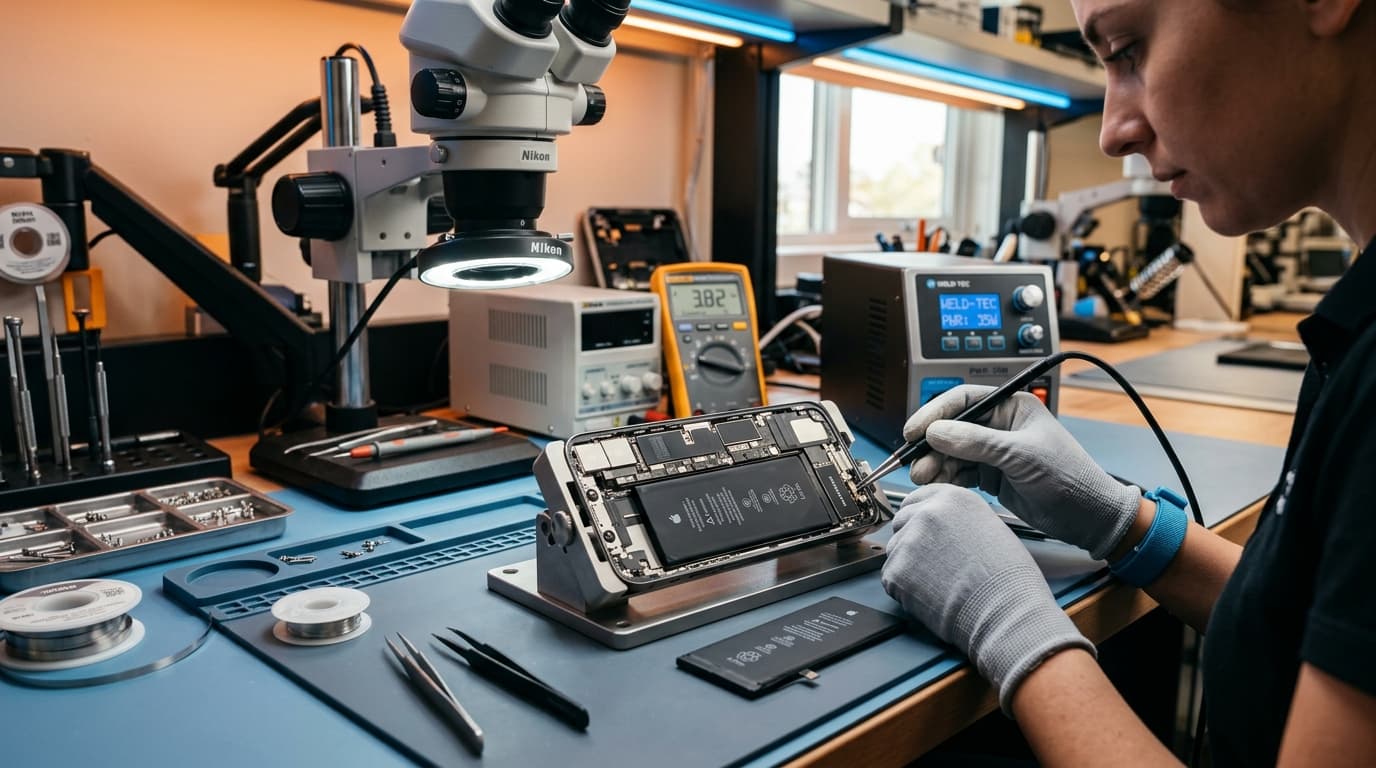
iPhone 16 & 17 Display Repair in 2026: OLED Technology & Guide

Cracked or damaged your iPhone 16 or iPhone 17 screen? This expert guide breaks down the advanced OLED display technology, repair options, genuine vs third-party parts, and why choosing a certified service center in Bangalore ensures your display performs like new.
Introduction: The Most Expensive Component on Your iPhone
The display is the single most interacted-with component on any smartphone, and on the iPhone 16 and iPhone 17 series, it's also one of the most technologically advanced—and expensive—parts to replace. Apple's 2025-2026 lineup features Super Retina XDR OLED panels with ProMotion 120Hz adaptive refresh, Always-On Display capability, and the Dynamic Island. Understanding what goes into these displays is critical before you decide how and where to get a repair done.
At iOne Care Technology in Bangalore, we handle dozens of iPhone display repairs every week. In this guide, we share our professional insights on the technology behind these screens, the repair process, key repair considerations, and how to make the right decision when your screen cracks.
1. Understanding iPhone 16 & 17 Display Technology
Before diving into repairs, it helps to understand what makes these displays special—and why repair quality matters so much.
- Super Retina XDR OLED: Unlike traditional LCD screens, OLED panels have self-emitting pixels. Each pixel produces its own light, delivering true blacks, infinite contrast ratios, and HDR peak brightness up to 2000 nits on the iPhone 17 Pro.
- ProMotion 120Hz: The adaptive refresh rate adjusts dynamically from 1Hz to 120Hz. This technology is embedded in the display driver IC—cheap replacement screens often lack this, resulting in fixed 60Hz operation and noticeably less fluid scrolling.
- Ceramic Shield Front Cover: Apple's Ceramic Shield, developed with Corning, embeds nano-ceramic crystals into the glass substrate. It's 4x more drop-resistant than pre-iPhone 12 models, but it's not scratch-proof—micro-abrasions from sand, keys, and pocket debris still accumulate.
- True Tone & P3 Wide Colour: Six-channel ambient light sensors calibrate white balance in real-time. Third-party screens frequently lack True Tone support, making colours appear cold and unnatural under indoor lighting.
2. Common Display Damage Scenarios We See
From our repair lab in Bangalore, here are the most frequent display issues across the iPhone 16 and 17 lineup:
- Corner-Impact Cracks: The #1 damage type. A drop onto a hard surface at an angle creates spider-web cracks radiating from the corner. The OLED panel underneath may still function, but touch sensitivity near cracks is often compromised.
- Green Line / Dead Pixel Lines: A vertical green or white line appearing on the display—typically caused by a flex cable micro-fracture from a drop. This is an OLED-specific failure that LCD screens don't exhibit.
- Ghost Touch / Phantom Inputs: The screen registers taps you didn't make. Usually caused by a damaged digitiser layer or water ingress affecting the touch controller.
- Face ID Failure After Drop: On iPhone 16 and 17 Pro models, the TrueDepth camera and Face ID module are integrated into the display assembly. A severe drop can misalign the dot projector, causing Face ID to stop working even if the screen looks fine.
- Brightness Dimming / Yellow Tint: Gradual OLED degradation—more common on devices used in extreme heat (Bangalore summers!) or with Always-On Display running at max brightness for extended periods.
3. Genuine Apple Parts vs Third-Party Screens: The Real Difference
This is where most consumers get confused—and where cutting corners can cost you more in the long run.
- Genuine Apple Displays: Samsung or LG-manufactured OLED panels with Apple's proprietary calibration data. Support True Tone, ProMotion, Always-On Display, and pass Apple's parts pairing verification. You get the "Genuine Apple Part" confirmation in Settings → General → About.
- High-Quality Aftermarket (Soft OLED): Third-party OLED panels that look similar but use different sub-pixel arrangements. Colours may shift slightly, max brightness is typically 15-20% lower, and ProMotion may not work. True Tone can be transferred using specialised programming tools.
- Budget Aftermarket (Hard OLED / Incell LCD): The cheapest option, but with significant trade-offs: no Always-On Display, fixed 60Hz, noticeably thicker assembly, reduced touch responsiveness, and drastically lower colour accuracy. We strongly advise against these for iPhone 16 and 17 series.
Our recommendation: Always opt for genuine Apple or premium aftermarket OLED panels. At iOne Care Technology, we offer both options with full transparency on what you're getting.
4. The Professional Repair Process: Step by Step
Here's what happens when you bring your iPhone to our Bangalore service center for a display repair:
- Step 1 — Diagnostic Assessment (15 min): We perform a comprehensive pre-repair diagnostic. This includes touch grid testing, Face ID verification, front camera functionality, proximity sensor check, and internal inspection for water damage indicators.
- Step 2 — Component Preparation: If using genuine Apple parts, the new display assembly includes the full OLED panel, digitiser, and Ceramic Shield cover glass pre-bonded in a dust-free environment. For aftermarket panels, we transfer the earpiece speaker, proximity sensor flex, and ambient light sensor from the original assembly.
- Step 3 — Precision Disassembly: Using calibrated pentalobe and tri-point screwdrivers, we remove the display assembly. The iPhone 17 Pro uses a new adhesive gasket system for IP68 waterproofing—this must be carefully cut and replaced to maintain water resistance.
- Step 4 — True Tone & Serial Transfer: Using Apple's proprietary System Configuration tool (or equivalent professional programmers for aftermarket), we transfer the original display serial number and True Tone calibration data to the new panel. This ensures colour accuracy matches factory settings.
- Step 5 — Post-Repair Verification: Full functionality testing: 120Hz ProMotion, True Tone, Face ID, auto-brightness, 3D Touch / Haptic Touch, and IP68 seal integrity verification.
5. Display Replacement Options & Considerations in 2026
Display replacement options vary based on the model, panel tier, and calibration requirements. Key factors to review before proceeding include:
- Standard Models (iPhone 16 & 16 Plus): High-brightness 60Hz OLED panels requiring True Tone serial transfer and fresh perimeter IP68 seals.
- Pro Models (iPhone 16 Pro & 17 Pro): 120Hz ProMotion LTPO panels with integrated Dynamic Island sensor cutouts and ultra-narrow bezel alignments.
- Pro Max Models (iPhone 16 Pro Max & 17 Pro Max): Large-format 6.9-inch panels demanding precision alignment fixtures and rigorous multi-touch calibration.
Note: At iOne Care Technology, we inspect each device first and provide an upfront quotation based on your preferred display tier, including labor, waterproof seal replacement, and multi-point testing.
6. Protecting Your Investment: Prevention Tips
The best repair is the one you never need. Here's how to protect your iPhone display:
- Tempered Glass Screen Protector: A quality 9H tempered glass protector absorbs impact energy that would otherwise crack your Ceramic Shield. Replace it every 6-8 months or immediately after a visible crack.
- MagSafe-Compatible Case with Raised Edges: Cases with a 1.5mm+ raised lip around the screen create a buffer zone during face-down drops—the single most common damage scenario.
- Avoid Extreme Temperature Swings: Moving from an air-conditioned room (22°C) to Bangalore's outdoor heat (38°C+) causes thermal stress on the OLED adhesive layer. Avoid leaving your phone on car dashboards or in direct sunlight.
- AppleCare+ Consideration: If you enrolled in AppleCare+ at device purchase, verify your policy status as accidental damage claims may be eligible for direct OEM handling.
7. Red Flags: How to Spot a Bad Repair Job
If you've already had a screen replaced elsewhere and something feels off, watch for these warning signs of a subpar repair:
- True Tone Missing: Go to Settings → Display & Brightness. If the True Tone toggle has disappeared, your original calibration data wasn't transferred.
- "Unknown Part" Warning: Settings → General → About may show a "Non-genuine Apple part" warning. While this doesn't affect functionality, it indicates aftermarket parts were used (which should have been disclosed).
- Uneven Backlighting / Colour Banding: Tilt your screen in a dark room showing a solid grey image. Cheap OLED panels show visible colour banding and uneven luminance.
- Gaps Between Screen and Frame: A properly repaired iPhone has zero visible gap between the display and the aluminium/titanium frame. Gaps indicate incorrect adhesive application—and compromised water resistance.
- Auto-Brightness Not Working: The ambient light sensor must be carefully transferred during repair. If auto-brightness stops working, the sensor was damaged or not reconnected.
Why Choose iOne Care Technology for Display Repairs
At iOne Care Technology, we've built Bangalore's most trusted iPhone repair service through rigorous standards:
- Certified Technicians: Our team holds Apple-recognised certifications and undergoes continuous training on the latest models and repair techniques.
- Genuine & Premium Parts Only: We never use budget LCD/Hard OLED panels. Every customer is informed upfront about part quality and service estimates.
- Same-Day Service: Most display repairs are completed within 60-90 minutes. Walk in, or use our free pickup and delivery service across Bangalore.
- Full On-the-Spot Testing: Complete multi-point touch, color uniformity, and True Tone inspection verified with the customer before handover.
- Water Resistance Restoration: We replace the IP68 adhesive gasket on every repair, something many repair shops skip to save time.
Conclusion: Don't Compromise on Your Display
Your iPhone's display is where you experience everything—messages, photos, videos, work, and entertainment. A damaged or poorly repaired screen doesn't just look bad; it compromises touch accuracy, colour fidelity, brightness, and even the structural integrity of your device.
Whether you've just cracked your iPhone 17 Pro Max or you're dealing with ghost touch on an iPhone 16, the quality of your repair matters as much as the speed. At iOne Care Technology, we combine Apple-grade expertise with transparent service estimates and genuine parts to deliver repairs that look and perform indistinguishable from factory new.
Visit us at our Bangalore service center or call for a free diagnostic assessment. Your iPhone deserves the best care.
Need Professional Repair?
If you're experiencing device issues, our certified technicians are here to help. Get fast, reliable repairs with genuine parts and thorough quality testing.